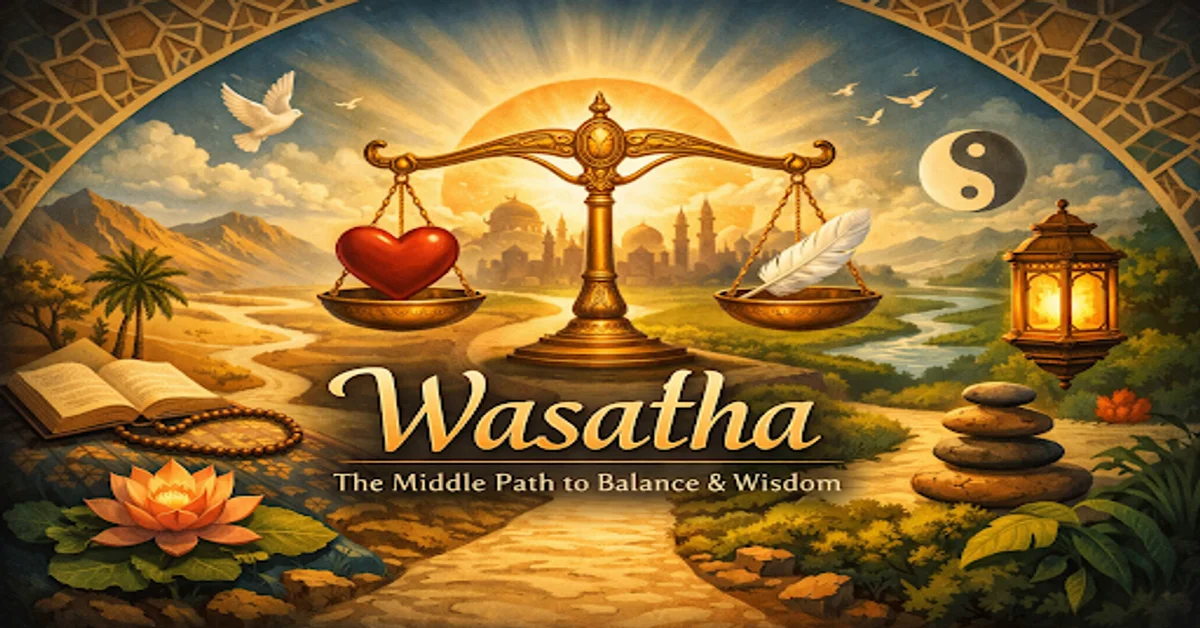
Wasatha is a powerful framework for living with intention, fairness, and emotional strength. Rooted in ancient ethical wisdom, Wasatha calls people to avoid extremes and choose proportionate, justice-centered action. In turbulent times of polarization, Wasatha shines as a stable compass: guiding individuals, communities, and leaders toward clarity without dogmatism.
This principle is both inward-facing and outward-facing. It trains the heart to practice emotional regulation and the mind to exercise contextual judgment, while also pushing societies toward equitable, measured policy. In short, Wasatha offers practical, trustworthy guidance for anyone seeking calm, courageous, and constructive action in a noisy world.
RELATED: Tasyyblack: Style, Trends, and Identity
What Does Wasatha Mean?
The word Wasatha comes from the Arabic root w-s-ṭ, literally meaning “middle” or “center.” But this middle is not passive or vague — it’s an engaged, morally wise center that chooses proportion over excess. Wasatha stands for a balanced approach that is active, discerning, and ethically grounded: the ideal midpoint between neglect and fanaticism.
Importantly, Wasatha is not the same as neutrality or passivity. Neutrality can be detachment; Wasatha demands moral engagement. It differs from a compromise that sacrifices justice for convenience. Instead, Wasatha aims for fairness and proportion — a “best middle” tailored to context. (Related: Wasatha meaning, middle path Islam.)
Historical and Religious Foundations of Wasatha
The concept of Wasatha is deeply anchored in the religious language of Islam. The Quran refers to the Muslim community as “ummatan wasatan” — often translated as a middle, balanced nation. This phrase is an ethical commissioning: to act as fair, balanced witnesses in society, holding both compassion and justice together.
The example of Prophet Muhammad further grounds Wasatha in lived practice. His teachings and dispositions illustrate moderation in worship, generosity without extravagance, and justice without cruelty. Islamic jurisprudence (fiqh) operationalizes Wasatha through ijtihad — reasoned interpretation — which allows principles to be applied proportionately in changing contexts.
Cultural Expressions of Wasatha
Wasatha surfaces in day-to-day traditions, rituals, and arts across communities influenced by Islamic thought. Festivals that honor cycles of nature, harvest, and communal reciprocity celebrate a balance between gratitude and aspiration. Similarly, family customs and oral storytelling often pass down nuanced lessons about moderation that shape moral character over generations.
Art and craft also echo Wasatha’s aesthetic: measured patterns, balanced rhythms, and harmonious motifs communicate the ethic of proportion. Music, pottery, textile patterns, and communal meals become vehicles for transmitting values of restraint, generosity, and social responsibility — a cultural tapestry woven with the thread of balance. (Related: Wasatha in daily life, cultural balance.)
Wasatha in Comparative Philosophy
The idea of a virtuous midpoint appears across philosophical traditions. Aristotle described the “Golden Mean” — excellence as a mean between two vices. Buddhism teaches a Middle Way between sensual indulgence and severe asceticism; Taoist thought celebrates Yin-Yang balance between opposites. These parallels show a shared human insight: extremes often fracture life; balance heals it.
What sets Wasatha apart is its emphatic moral call. Unlike a purely psychological or metaphysical middle, Wasatha insists on social responsibility: balance must be exercised to protect the vulnerable, promote justice, and sustain the common good. It’s not merely a personal tempering — Wasatha is an ethic of civic courage.
Psychological and Scientific Insights
Modern psychology supports Wasatha’s prescriptions. Cognitive flexibility — the ability to hold multiple perspectives and adapt — correlates strongly with better problem-solving, less polarizing thinking, and greater empathy. Mindfulness and intentional living practices cultivate this flexibility, enabling calmer, wiser responses.
Neuroscience explains how balance works in the brain. The prefrontal cortex helps us pause, evaluate, and choose proportional responses, while the amygdala drives impulsive emotional reactivity. Training the mind through mindful practices strengthens prefrontal control, lowering the risk of extreme, amygdala-driven actions. This biological grounding shows why Wasatha’s habit of the intentional pause isn’t just spiritual advice — it’s a brain-healthy strategy.
Applying Wasatha in Modern Life
Wasatha translates into practical habits that stabilize daily life. In the personal realm, it guides work-life balance, sustainable health routines, and thoughtful financial choices. Choosing moderation in consumption and ambition often leads to longer-term wellbeing rather than burnout.
In relationships, Wasatha fosters honest communication that pairs assertiveness with kindness. Boundaries exist without cruelty; empathy exists without self-abandonment. Professionally, Wasatha-shaped leadership encourages innovation balanced by accountability, inclusion without tokenism, and clarity without dogma. Even online, Wasatha advises mindful technology use — staying informed but resisting sensationalism.
Common Misunderstandings About Wasatha
Many people mistake Wasatha for passivity, false compromise, or a bland middle ground. These are misunderstandings. Wasatha is not about silence in the face of injustice; rather, it calls for proportionate, well-reasoned action. It rejects extremes while demanding courage to act where needed.
Another myth: Wasatha weakens passion. On the contrary, it channels passion toward sustainable, constructive ends. True Wasatha harnesses energy through wisdom — transforming fervor into effective, principled action. Correcting these myths allows Wasatha to function as a dynamic, potent ethic rather than a timid middle.
Practical Framework to Live Wasatha
Living Wasatha can be distilled into five pillars: self-awareness, intentional pause, contextual thinking, proportional response, and regular recalibration. First, self-awareness helps you spot tendencies toward excess or avoidance. Second, the intentional pause (breath, prayer, reflection) gives the prefrontal cortex time to engage.
Third, contextual thinking reminds you that balance shifts with circumstances — what’s moderate in one case might be excessive in another. Fourth, aim for responses proportional to the issue: escalate only when necessary, de-escalate when possible. Finally, recalibrate regularly: schedule reflection, mentorship, or community checks to stay aligned with Wasatha’s aims.
Challenges to Preserving Wasatha Today
Wasatha faces real pressures from globalization, social media, and political polarization. Globalization can dilute local practices that used to embody balance; mass media often amplifies extremes for attention; and economic stressors push people toward short-term survival rather than reflective moderation.
Young people may find traditional expressions of Wasatha out of sync with rapid cultural flux. To preserve the spirit of Wasatha, communities must translate its wisdom into accessible, relevant forms — not by fossilizing the past, but by creatively adapting its heart to modern contexts.
Technology as a Tool for Promoting Wasatha
Technology is not inherently an enemy of balance. Thoughtful use of digital tools can amplify Wasatha. Podcasts and online courses can teach ethical decision-making and mindfulness practices. Apps offer guided meditations and habit trackers that reinforce intentional living. Virtual reality and digital archives can recreate cultural rituals that instill communal values.
The key is purposeful design: technology used as a mirror for reflective practice and civic engagement can spread Wasatha’s principles far beyond local communities. When platforms incentivize thoughtful reflection over outrage, Wasatha gains a powerful ally.
Future Prospects of Wasatha in the Modern World
Wasatha’s future is bright if integrated into education, leadership training, and public policy. Teaching moderation in schools — not as bland compromise but as ethical judgement — equips youth with civic resilience. In leadership, Wasatha-informed approaches promote sustainable, inclusive governance.
Cultural storytelling — films, books, and art — can reanimate Wasatha as aspirational and modern. Policy frameworks that prioritize proportional justice, sustainability, and social safety nets mirror Wasatha’s ethical core. Through creative adaptation, Wasatha can become a mainstream resource for balanced progress. (Related: Wasatha leadership, sustainable balance.)
RELATED: Galoble: Meaning, Usage, and Digital Impact
Frequently Asked Questions
What does Wasatha mean?
Wasatha means a balanced, moderate approach — an engaged middle that favors proportionate, ethical action over extremes.
Was Wasatha neutrality or inaction?
No. Wasatha is an active responsibility. It rejects passive neutrality and instead promotes thoughtful intervention aligned with justice.
Is Wasatha only a religious concept?
While rooted in Islamic texts and practice, Wasatha’s core idea — balance and proportionality — is universal and applicable across cultures and professions.
How can Wasatha be applied in daily life?
Practice self-awareness, use an intentional pause before reacting, think contextually, respond proportionately, and recalibrate through reflection and community support.
Why is Wasatha important today?
Amid polarization and rapid change, Wasatha helps individuals and societies maintain clarity, fairness, and sustainable well-being.
Summary
Wasatha matters because balance is a radical act in polarized times. The world needs frameworks that combine inner calm with outward courage, personal restraint with social responsibility. Wasatha offers a tested, humane path to navigate complexity with wisdom and compassion.
Embracing Wasatha means choosing actions that are proportionate, just, and sustainable. It means reviving an ethic that protects the vulnerable while fostering flourishing. For individuals, leaders, and communities, Wasatha can be the steadying force that turns discord into constructive change.